International experience and track record. Able to serve several regions at once since 1992.
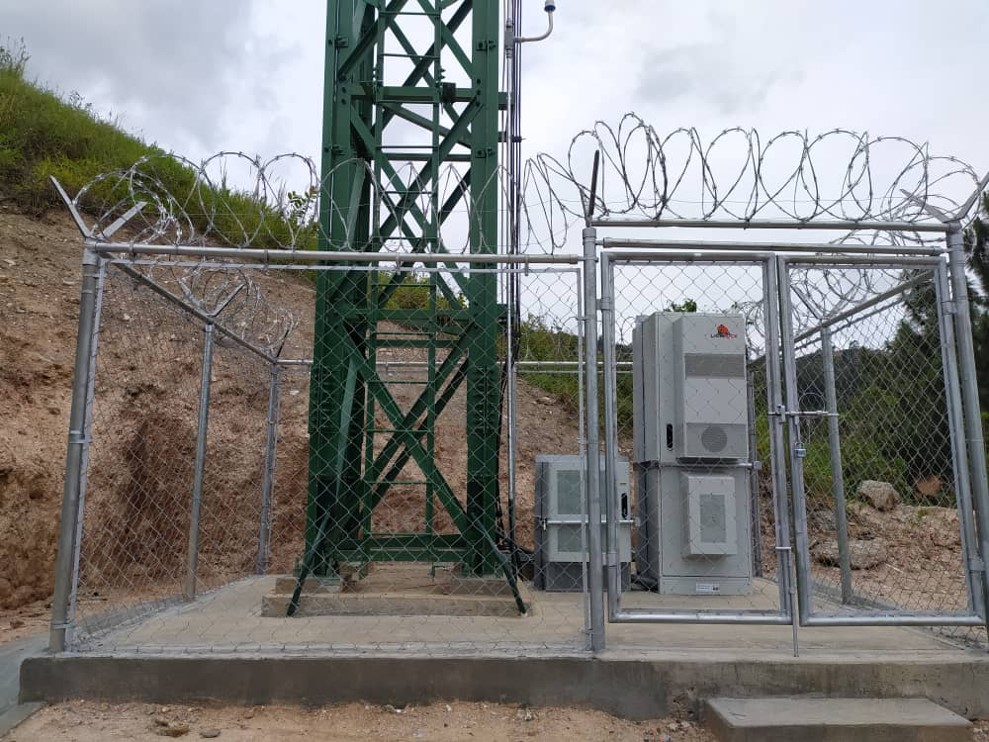
Full capability end to end
The only provider integrating the entire chain on radio base station projects.
Site Acquisition, Permitting and Negotiation
The first phase of the rollout cycle, site acquisition: we find the locations that meet the coverage target, negotiate the lease with the owner and handle the full permitting process until the site is ready to build. It is the stage that delays a rollout most when it is underestimated, and the one we have been solving since 1992.
Site hunting by coverage
Geospatial analysis with GIS technology to find candidate sites that meet the carrier's coverage and capacity target, assessing available height, line of sight and access.
CloudRF · GIS
Site survey and technical feasibility
Field visit with a photographic survey, checking vehicle access, availability of an electrical service entrance, space for the foundation and ground conditions.
Site acquisition
Lease and colocation agreements with owners of land and rooftops, including rights of way for the electrical service entrance and the fiber.
End-to-end permitting
Municipal authorities (zoning variables and building permit), INAC for height restrictions, the Ministry of Ecosocialism, municipal councils and other regulators.
Site file
Each site is handed over with its full file: contract, permits, survey, coordinates and handover certificate, ready for the construction crew to move in.
Applicable regulations
- Telecommunications Act — administrative licence and spectrum allocation from CONATEL
- INAC — height restrictions and obstacle marking in obstacle limitation surfaces
- Municipal ordinances — zoning variables, conforming use and building permit
- Ministry of Ecosocialism — impact on protected natural areas (ABRAE) where the site requires it
- Decreto 1.257 — environmental impact study where the site requires it
- Venezuelan Civil Code — lease agreements and rights of way
- ITU-R P.1546 — VHF/UHF coverage prediction
- COVENIN 2249 — illuminance in work areas during inspection
- ISO 9001:2015 — document traceability of each site file
- GIS technology — georeferencing and geospatial analysis with CloudRF
Civil, Electrical and Mechanical Infrastructure Engineering
Design and construction of all the infrastructure that supports and powers a radio base station: from the soil survey and the tower foundation to the grounding system and the distribution switchboards. Multidisciplinary works (civil, mechanical and electrical) under a single contract, without splitting responsibility among several contractors.
Soil survey, earthworks and foundations
Standard Penetration Test (SPT) and soil classification to determine the bearing capacity. That figure sets the bearing depth and sizes the footing. It covers excavation, compaction, formwork, reinforcement and concrete pouring. This is the item that literally holds up everything else: an undersized foundation compromises the entire tower.
SPT · COVENIN 1756 · ACI 318
Power and metering
Low or medium voltage service entrance, DC and AC power systems, distribution switchboards, metering equipment and protection coordinated to the National Electrical Code.
Grounding system
Design and installation of ground grids and lightning protection, with soil resistivity measurement and verification of ground resistance to IEEE 80/81.
IEEE 80 · IEC 62305
Multidisciplinary works (civil, mechanical and electrical)
Full delivery under one contract: self-supporting and guyed structures, perimeter fencing, equipment shelter, raceways and mechanical assembly.
Monitoring with VenIoT®
The infrastructure is handed over already instrumented: VenIoT reports remotely on power status, shelter temperature, door opening and intrusion at the site.
Applicable regulations
- Urban Planning Act — zoning variables and building permit
- LOPCYMAT / NT-01-2008 (INPSASEL) — work at height, excavations and confined spaces
- COVENIN 1756 — seismic-resistant structures — the basis for foundation design
- COVENIN 1753 — design and construction of structural concrete works
- COVENIN 200 (CEN) — National Electrical Code: raceways, switchboards and protection
- ANSI/TIA-222 — wind loading and structural design of telecommunications towers
- ASTM D1586 — standard penetration test (SPT) for the soil survey
- ACI 318 — reinforced concrete design for footings and pedestals
- IEEE 80 e IEEE 81 — design and measurement of the grounding system
- IEC 62305 — lightning protection
- ISO 9001:2015 — on-site quality control and handover dossier
Radio Frequency and Transmission Deployment
Installation, configuration and commissioning of the radio frequency and transmission systems that put a site on air: antenna mounting and alignment, microwave links with line-of-sight calculation, and fiber optic transport. We work both for carriers and for equipment manufacturers.
Microwave links and RF
Microwave link deployment with Line of Sight calculation and Fresnel zone clearance over the terrain profile, antenna mounting and fine alignment, and commissioning with received power measurement.
PathLoss · Open Tower
Optical transport fiber
Dark Fiber, Fiber to the Tower (FTTT) and FTTx. ODF (Optical Distribution Frame) installation, fusion splicing and certification of the segment.
Antenna and radiating system installation
Installation of sector antennas, RRUs (Remote Radio Units) and transmission lines, controlling azimuth, mechanical and electrical tilt, and connector sealing.
Medium and high voltage electrical supplies
Medium and high voltage materials: cables, transformers and fittings. Omsaica is a partner of Grupo De Biase, which shortens procurement lead times and improves pricing.
Integration with VenIoT®
Once commissioning is complete the site is left under monitoring: VenIoT watches power, temperature and intrusion, and escalates the alarm before the operator notices any degradation.
Applicable regulations
- Telecommunications Act — use of radio spectrum allocated by CONATEL
- CONATEL — Norma de radiaciones no ionizantes — exposure limits and site signage
- LOPCYMAT / NT-01-2008 — work at height with certified harness and lifeline
- ITU-R P.530 — propagation and availability of point-to-point links
- ITU-R P.525 / P.526 — attenuation and diffraction calculation over the terrain profile
- ICNIRP — international reference for electromagnetic field exposure
- IEC 61400-2 / ANSI-TIA-222 — mast loading from the exposed antenna area
- ITU-T G.652.D — single-mode fiber on the transmission segment
- ISO 9001:2015 — commissioning protocol and acceptance certificate
- Work-at-height certification — personnel certified for tower climbing
Aerial and Underground Fiber Optic Deployment
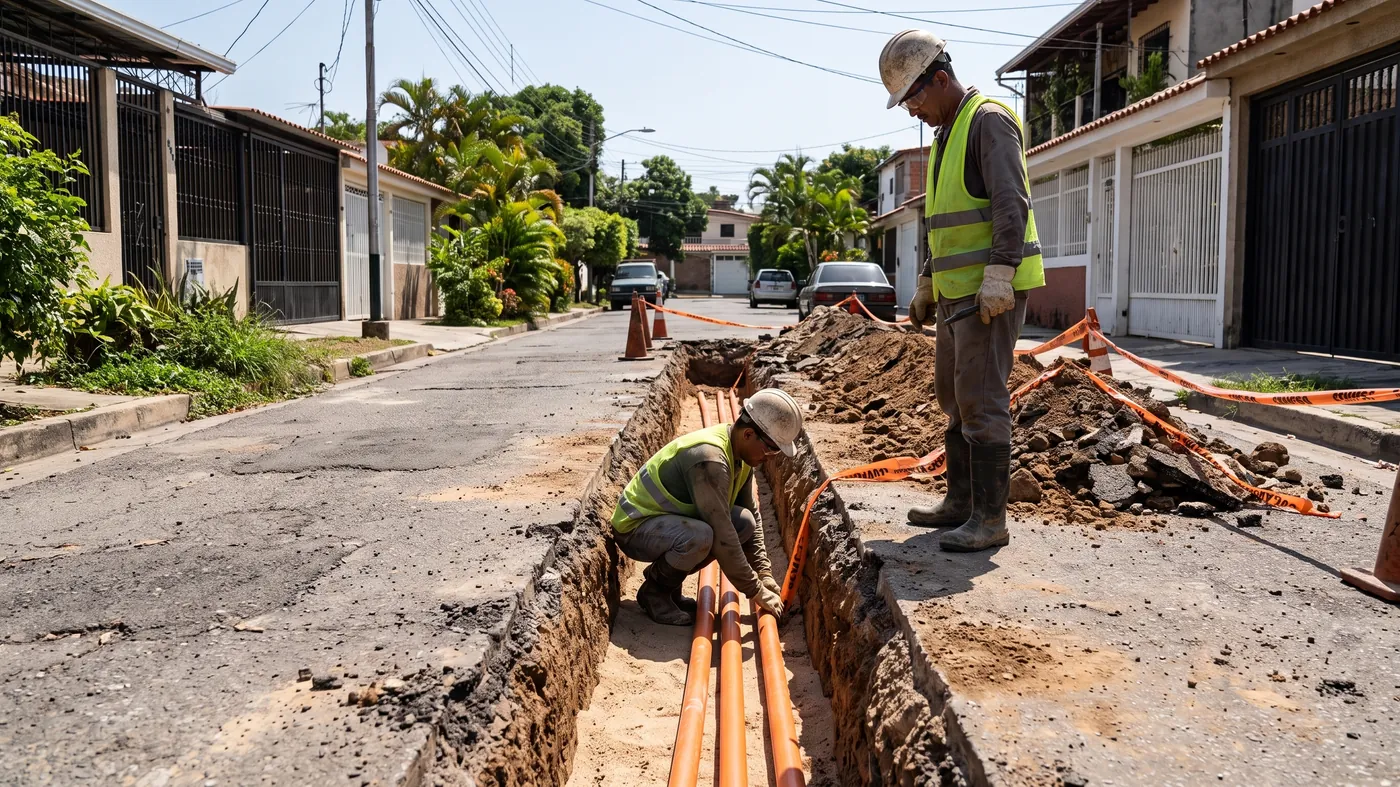
We design, duct, install, splice and certify optical fiber networks for carriers, housing developments and industry, under an EPC (Engineering, Procurement and Construction) contract. One party responsible, from the route survey to the per-fiber test protocol.
Aerial deployment
ADSS (All-Dielectric Self-Supporting) and figure-8 cables on our own poles or those of CORPOELEC or CANTV, with span, sag and stringing tension calculations. OPGW (Optical Ground Wire) on medium and high voltage lines for power utilities.
Underground deployment
Ducting with HDPE (ASTM F2160) or PVC conduit, triple duct and microducts, with precast manholes and handholes. Cable installed by jetting or pulling, and road crossings by horizontal directional drilling.
Route survey and engineering
Field survey, GIS/KMZ georeferencing, verification of poles and interferences, ducting report and optical link budget.
GIS · CloudRF
Splicing and certification
Arc fusion splicing, bidirectional OTDR (Optical Time-Domain Reflectometer) testing at 1310/1550 nm and insertion loss measurement. Per-fiber protocol and as-built drawings.
Bidirectional OTDR
Applications
Fiber to the tower (FTTT) backhaul for 4G/5G, FTTH/FTTx networks in housing developments, private industrial and oil and gas networks, and intercity backbone links.
Monitoring with VenIoT®
Once the network is in place, VenIoT monitors power, cabinet opening, temperature and intrusion at the nodes and splice manholes remotely.
Applicable regulations
- Telecommunications Act — licences and spectrum allocation from CONATEL
- Municipal ordinances — pavement breaking and use of public space
- Decreto 1.257 — environmental assessment where the route requires it
- ITU-T G.652.D / G.657.A — single-mode fiber
- ITU-T L.100, L.101 y L.102 — duct, direct-buried and aerial cables
- IEC 60794-3 — outside plant cable
- IEEE 1222 / IEEE 1138 — ADSS and OPGW cables on energized lines
- ANSI/TIA-758 y TIA-568.3 — outside plant and optical cabling
- COVENIN 200 (CEN) — clearances in trenches shared with medium voltage
- TIA-526-7 / IEC 61280-4-2 — insertion loss measurement
- ISO 9001:2015 — certified quality management system
- CANTV and CORPOELEC specifications — outside plant and pole attachment
- LOPCYMAT / NT-01-2008 — work at height and near energized lines

VenIoT® — Remote Infrastructure Monitoring and Control
Our own Internet of Things (IoT) platform to monitor and operate critical infrastructure remotely: power, climate, security and processes. It began as a problem of our own — knowing what was happening at hundreds of scattered radio base stations without sending someone — and today it is a product running at telecommunications sites, industrial plants and oil fields.
See VenIoT Demo →Power and climate monitoring
Measurement of electrical variables (voltage, current, frequency, kWh), genset and battery bank status, shelter temperature and air conditioning operation.
Security and access control
Cabinet and door opening, intrusion and smoke detection, with a record of who entered and when. It cuts copper and battery theft, the biggest loss at remote sites.
Remote control and automation
It does more than watch: it lets you switch equipment on, off and reprogram it remotely (genset start, load transfer, equipment reset), with confirmation that the command was carried out.
IoT: LoRa, WiFi 6, 4G/5G and satellite
The link is chosen to suit the site: LoRa for long range and low power in open field, WiFi 6 inside the plant, 4G/5G where there is coverage, and satellite where there is none.
LoRaWAN · MQTT · Modbus
Works without a permanent connection
The node decides on site according to the rules loaded into it and syncs when the link comes back. In Venezuela, where both connectivity and power are intermittent, that autonomy is the difference between a system that works and one that does not.
Applicable regulations
- Telecommunications Act — use of unlicensed (ISM) bands and licensed links
- Infogovernment Act — data handling in State-owned infrastructure
- LoRaWAN (LoRa Alliance) — long-range, low-power network for sensors
- IEEE 802.11ax (WiFi 6) — high-density local network on site
- MQTT (OASIS) — messaging protocol between node and platform
- Modbus RTU / TCP — reading of meters, UPS units and industrial equipment
- IEC 62443 — cybersecurity in industrial automation systems
- IP65 / IEC 60529 — ingress protection rating of outdoor cabinets
- ISO 9001:2015 — development and support under a certified management system
- In-house development — firmware, hardware and platform designed by Omsaica
All the deployment formats
Greenfield
Self-supporting towers built from scratch on open land. Heights from 30 to 80 metres.
Rooftop
Antennas and equipment on existing rooftops. A fast-deployment urban solution.
In-Building
DAS systems for indoor coverage in airports, shopping centres and corporate buildings.
Small Cells
Low-power, small-coverage cells that densify the network where the macrocell can no longer cope: shopping streets, stadiums and city centres.
Outdoor DAS
An outdoor Distributed Antenna System: one signal source feeds several remote antennas spread across the area to be covered.
Proven experience
Radio Base Stations, end to end — Venezuela
The only provider integrating the whole chain: site hunting, engineering, construction, RF deployment and maintenance.
Base Station Supervision — Colombia
Detailed engineering for Tenancy Growth, construction supervision and preventive maintenance.
In-Building 3G/4G — Maiquetía Airport
Engineering, construction and deployment of an indoor 3G and 4G network for mobile carriers.
Site Building Efficient — Telefónica
End-to-end provider for radio base station construction and maintenance.
Carriers and Towercos














Need to deploy telecommunications?
From site hunting to commissioning. A single provider for the whole cycle.